These seven of Chris’ paintings were present at the Celebration event. Enjoy by scrolling down the page. You can alternately view them in their own gallery here.
White Ibis
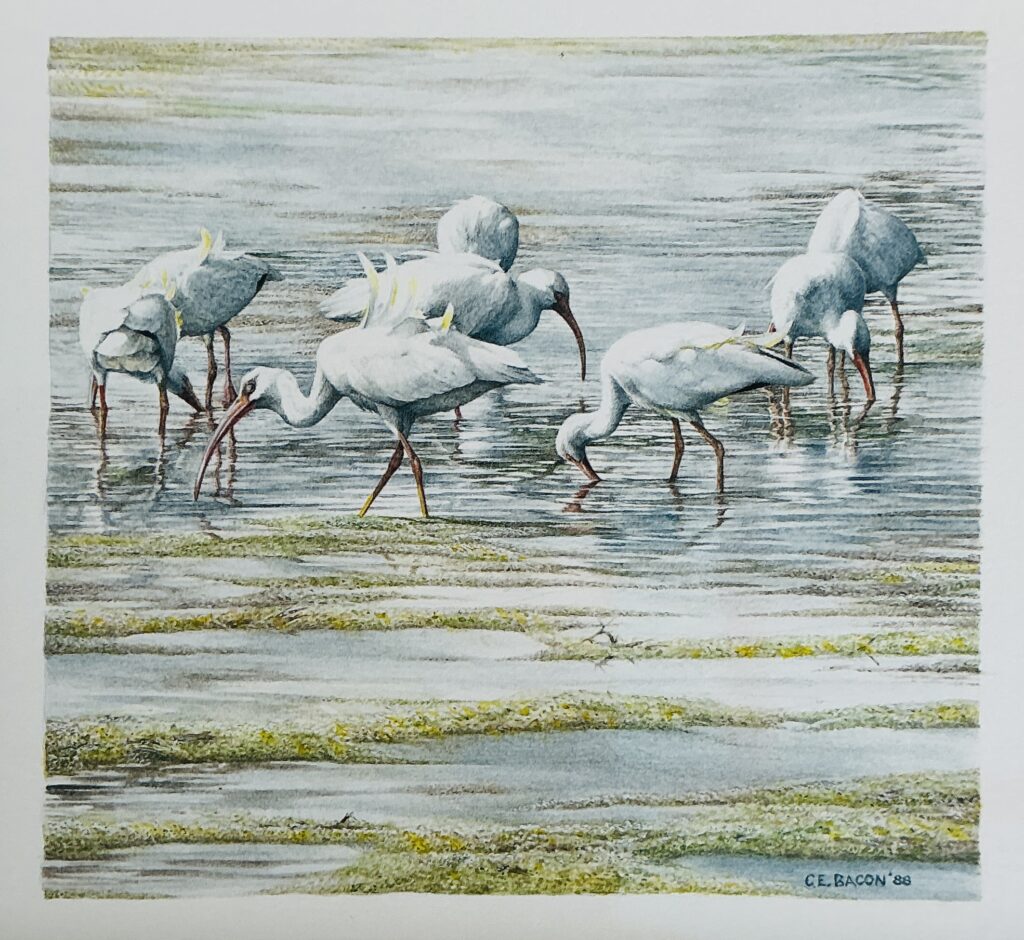
White Ibis 1988
watercolour
8 cm x 7 cm 3.15” x 2.75”
Collection of David and Andrea Shemilt
Grab a magnifying glass and take it all in! Chris became renowned for incredibly fine detail in his earlier paintings, often working with a single-hair paintbrush and a magnifying glass to capture the smallest “barbs and barbules” of each feather, as he expressed it. Artist Raymond Harris-Ching once viewed several of Chris’ hyper-detailed paintings in person, exclaiming in awe, “Madness!” These are truly awe-inspiring pieces.
Though Chris’ later work did continue to maintain a high level of detail and realism, he eventually employed comparatively looser, more expressive strokes in larger-format paintings. This gradual shift was a natural evolution of his artistic vision, which always encompassed a self-reflective element. No matter the level of detail or size of painting, each piece in Chris’ body of work will always be a part of him, symbolizing his journey as an artist and individual through the years. Each piece retains a “Chris Bacon” quality that makes it obvious from across a room, just who painted it. –Ashley
Study for Needle and Thread Alley

Study for Needle & Thread Alley
watercolour on arches paper
24.4 cm x 27.9 cm 10” x 11”
Needle & Thread Alley is one of our favourite spots in St George’s, Bermuda. Many of the streets carry such whimsical names from eras gone by. We have both sat on that little step to the left, taking a breather during our walks through the historic village.
Chris captured the spirit of this idyllic place so perfectly, I can feel the balmy atmosphere and smell the fragrant cedar creeping over the limestone wall. The house at the end of the alley peeks at you with curiosity, the windows like eyes.
Chris gifted me this painting, knowing how much I love it. It also represents a departure from Chris’ usual style of painting, one of several similar, looser watercolours he created depicting Bermuda scenes. He always thoroughly enjoyed painting them, both as a relaxing pastime for himself and a way to “visit” his favourite place on Earth. -Ashley
Moon Lights

Moon Lights (Least Tern and Royal Terns) 2008
acrylic on rag board
16.50 cm x 40 cm 6.50” x 15.75”
Collection of David and Andrea Shemilt
“None of the images I paint are photographic – meaning, I don’t paint things I’ve seen. Rather, I compose images in my head and spend a great deal of time drawing them out on paper, and tweaking that drawing until it is compositionally perfect. To me, these paintings are not about birds; birds are simply a vehicle I use to compose paintings. The paintings themselves are things that will hopefully manipulate the viewer into an experience I may have had, an experience of vastness perhaps, or a certain emotional feeling.” –Chris
For this painting, Chris had spent an afternoon on a sandspit in Cape Hatteras sketching Least and Royal Terns, when he suddenly “thought about seeing things in a different light.” Once home, he created a clay model of the Least Tern in the foreground to study and establish a believable shadow for the bird. This final painting distinguishes itself considerably from the sketch on the sandspit, venturing into an atmospheric wonderland representative of many of Chris’ imaginative pieces over the years. –Ashley
Awareness (Collared Aracari)
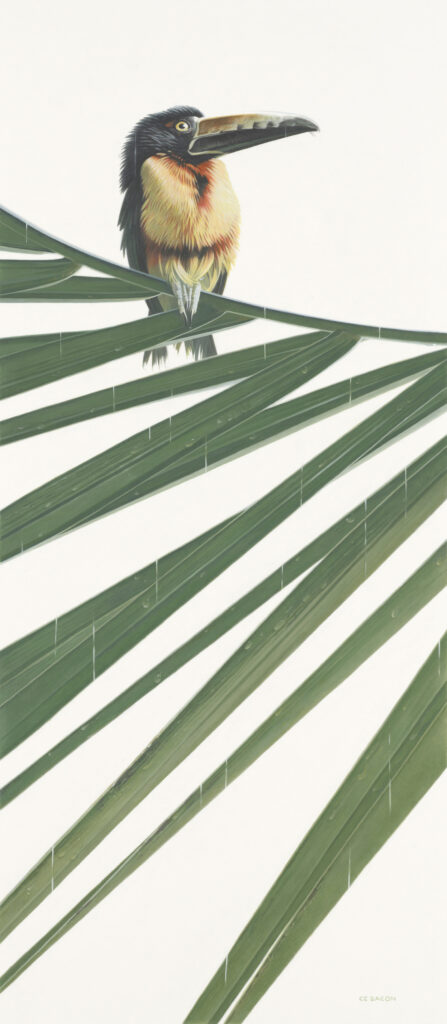
Awareness (Collared Aracari) 2022
watercolour on rag board
62.54 cm x 27.30 cm 24.625” x 10.75”
Collection of Peri Kolivaris and Lisa Singer Kolivaris
“Consciousness without thought…Birds, animals and plants have a lot to teach us about how to live more deeply in the present and how not to get lost in thought.” -Chris
Sarus Crane
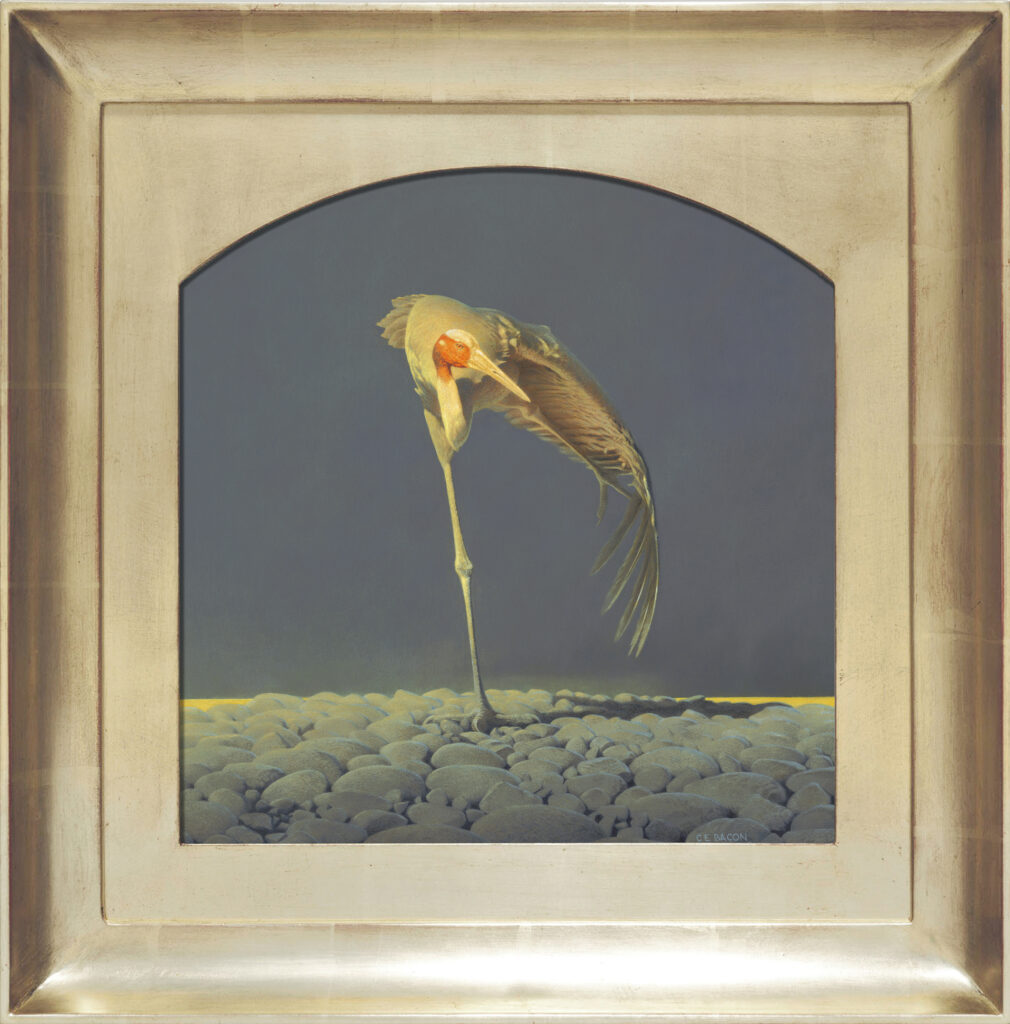
Sarus Crane 2003
alkyd on rag board
29.25 cm x 28 cm 11.50” x 11”
Collection of Joe Donnell and Michelle Kachur
Chris described the three-year process of painting the Sarus Crane: “Cranes are primeval-looking, with gangly gait and shape. They are the smartest of birds…but the shapes of them seemed prehistoric. I was getting images and shapes in my head, how I was going to deal with them. Originally in one of these thumbnail ideas, I had a crane standing on top of a hill…it was very dramatic-looking. There’s this ominous, prehistoric shape and a last bit of sunlight hitting the top of this thing…the light being extinguished…the shadow was beginning to climb up the leg of the bird.” He explained that this speaks of a storm brewing that surrounds the bird, yet the bird remains in the light. It became a self-portrait during a “rough time” in a former relationship. “He has his wing stretched out, because he is about to move on. The feelings I was having were beginning to manifest themselves in the painting… [the piece] was almost violent, it was so troubled. Originally it was a watercolour and I ran into technical problems… I [eventually] cut ten inches off the bottom and the composition changed…then I went at it in oil. As time went by, the painting developed a life of its own. They tell you what they need. Now, everything has mellowed, but I still have the drama [in the painting].”
Flotilla (Polish Mutes)
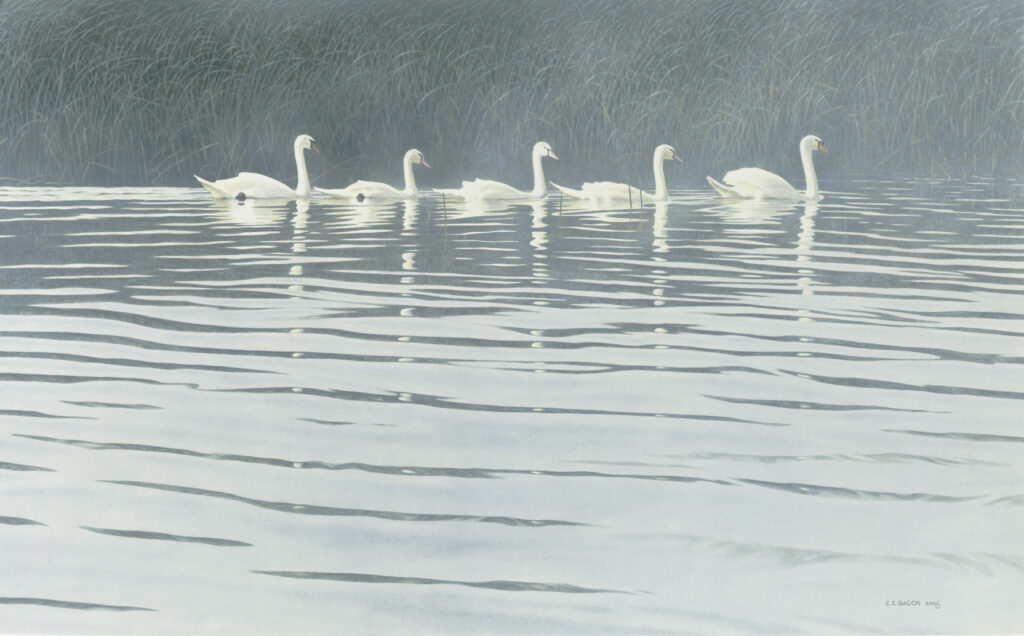
Flotilla (Polish Mutes) 2006
watercolour on rag board
48.50 cm x 77.50 cm 19” x 30.50”
Collection of Paul and Hilde Singer
Chris was asked by the acquirers of the painting — my wife and I — to speak about it on a day when we were all together, toasting the work as finally ours. What follows is Chris’s own conversational tour of the painting and its making.
“My goal was to produce the most beautiful, perfectly balanced, elegant piece of art that anybody had ever seen — that certainly I’d ever seen. And I just thought I can do this, I’m going to put my mind to it; and I spent the best part of seven months trying to achieve that. I think I got close to producing a very beautiful piece of art.
It’s a transparent watercolour on rag board. It’s a fairly heavy board. The swans have been masked off first with white paper, and then a wash went down over the whole thing. Then I peeled the masks off, and started putting all that in. Originally, when I had it first photographed, it didn’t have the mist flowing through it, so that came later — once I looked at the transparency after David Saltmarsh had shot the painting. I went back to it and spent another few weeks — after I thought it was finished — putting this mist in, which I think really added to the softness and the elegance and light to the mood, so it softened everything.”
Here Chris turned to the subject of the swans themselves — Polish mute swans, he noted, a variety whose cygnets are white while quite young, rather than the familiar grey of other species: “So we have three signets in the middle and two adults protecting as they move through and disappear into the mist…” He mentioned, with quiet delight, that he and Ashley had actually witnessed such a scene in person: all of them moving together in a row, an uncommon sight, but one that does occasionally occur in nature. “[I painted it in] 2006 — but it took me seven months. I probably started it in oh five.”
As our conversation drew to a close, standing together around the painting, I found myself drawn back to Chris’s opening words — his declared ambition “to produce the most beautiful, perfectly balanced, elegant piece of art that anybody had ever seen.” From the first moment we laid eyes on Flotilla, we knew with quiet certainty that we were looking at exactly that.
We told him so. As Hilde and I spoke about how deeply the painting had taken root in us — at the opening of our time together that day and again at the close of it — I noticed something pass across Chris’s face. A look of gentle vulnerability. Of humble wonder at being so fully seen. His was a tender soul, and in that moment it showed — graciously receiving our love for a work that had cost him something real, and given us something lasting. – Paul Singer
Sea & Sand (Lesser Yellowlegs)

Sea & Sand (Lesser Yellowlegs) 2025
acrylic on rag board
29.8 cm x 32 cm 11.75” x 12.62″
“Sea & Sand” is the final painting that sat on Chris’ easel, ready and beckoning for completion but ultimately not destined to reach the vision that Chris had in mind for it, due to his sudden illness and passing. It may not appear incomplete to the viewer, but as such, it is an unfinished piece. Perhaps it reflects the nature of life itself, that it is never truly finished with us.
A study exists for “Sea & Sand” which is very similar to this painting due to the fact that Chris was not able to fully resolve this piece. What differs the most between the study and this painting is the contrast in the latter of a moody sky against the blinding brilliance of the Sun hitting the water’s horizon. It appears to declare that, no matter what clouds attempt to darken the skies, the light always prevails.
Chris had chosen a quotation by American naturalist Peter Matthiessen that he felt spoke of this painting: “…and the beach bird stood immobile for a time, observing the turtles and a muskrat, two black ducks and a green heron, as if certain of its central place in a strange and beautiful universe” (emphasis added). -Ashley